
72 Seconds per Question: UPSC Prelims Time Management
By IAS Labs by Aptness.ai · 5 min read ·
100 questions. 120 minutes. That’s 72 seconds a question, and a wrong answer takes marks away. In Prelims, how you use time and when you guess can matter as much as what you know.
Where your 72 seconds go
- ~20 secRead the question and every statement carefully
- ~30 secRule out the options you know are wrong
- ~20 secDecide, or skip and move on
Statement questions (“How many of the above are correct?”) eat more time. Save it on the quick one-line factual questions.
Guess or skip? The maths, simply
| What you know | Chance of being right | Average marks from guessing |
|---|---|---|
| Nothing, pure guess among 4 | 1 in 4 | about 0 |
| One option ruled out | 1 in 3 | about +0.23 |
| Two options ruled out | 1 in 2 | about +0.67 |
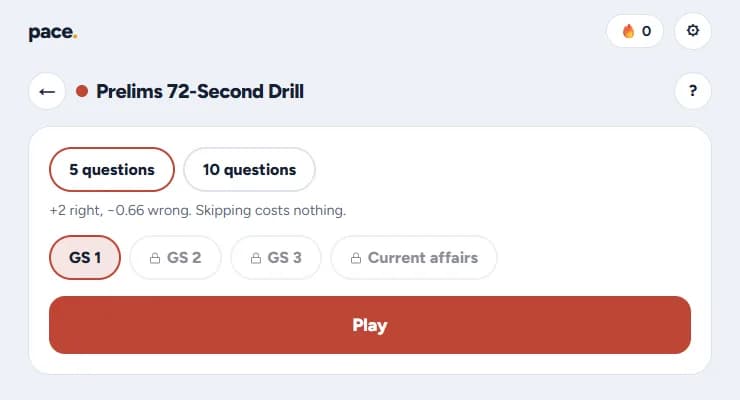
Practise it: the 72-Second Drill
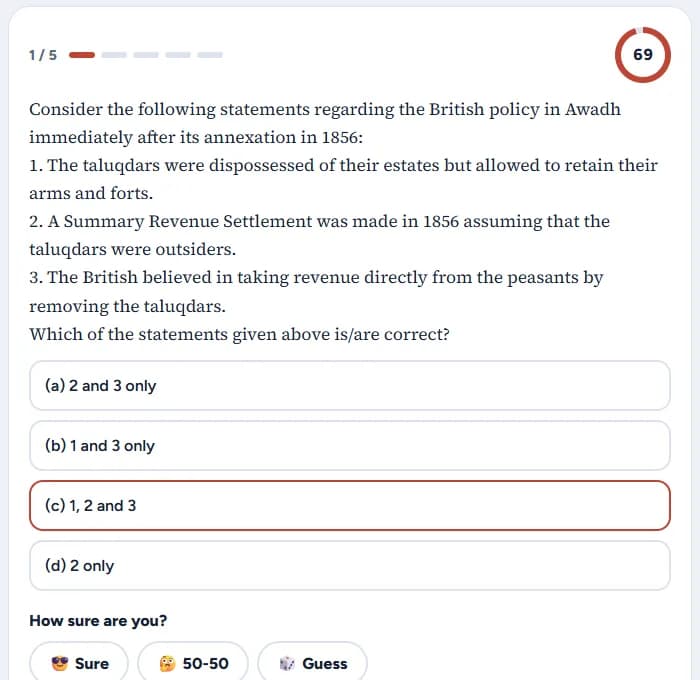
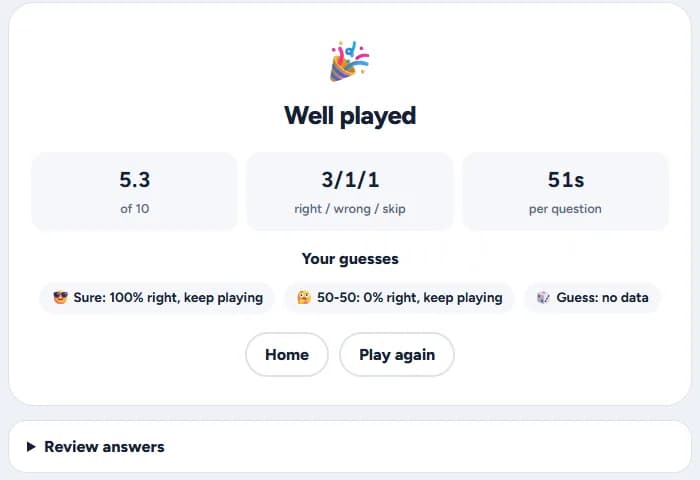
Every question runs on a 72-second clock. After you pick an answer, you say how sure you are: sure, 50-50 or a guess. Over time you’ll see whether your “sure” answers are really right, and when your guesses pay off.
For Mains: Decode the question
Many Mains marks are lost by misreading the question, not by not knowing the answer. Decode gives you 20 seconds to read a question, then asks what it really wants:
- DiscussLook at the issue from several sides, with reasons
- Critically examineWeigh both sides, then give your judgement
- CommentGive your view, backed by facts and examples
- ExamineGo deep into causes and effects
You also pick the word limit: 150 words for a 10-mark question, 250 for a 15-mark one.
Play the paper in two rounds
- Round 1 (about 75 minutes): answer every question you are sure of. Mark the 50-50s, skip the rest without a fight.
- Round 2 (about 35 minutes): go back to the marked 50-50s. Cut options, then decide.
- Last 10 minutes: check the answer sheet matches your choices. Don’t start new hard questions now.
One hard question early on shouldn’t eat the time of five easy ones later. Two rounds stop that from happening.
A trick for statement questions
In “Which of the statements given above is/are correct?” questions, you rarely need to know every statement. If you are sure statement 2 is wrong, cut every option that includes it. Often that leaves one or two options, and you know from the table above that a guess between two is worth it.
Mains timing, at a glance
- 3 hours, 20 questionsEach GS paper is 250 marks, so you get about 9 minutes a question.
- 10-mark questionsAbout 7 minutes for 150 words.
- 15-mark questionsAbout 11 minutes for 250 words.
- Don't skipA short answer to every question usually scores more than perfect answers to a few.
Mistakes to avoid
Quick questions
- Is the CSAT paper marked the same way?
- CSAT (Paper II) has 80 questions of 2.5 marks each, and a third of that, about 0.83, is cut for a wrong answer. It is qualifying: you need 33%.
- Should I attempt all 100 questions?
- Not blindly. Attempt what you know and the ones where you can cut at least one option. Your mock tests will show your own safe number.
- How do I get faster?
- Practise under the real clock. Speed comes from reading questions often, not from rushing on the day.