
Modern Indian History for UPSC: 1857 to 1947, on One Map
By IAS Labs by Aptness.ai · 5 min read ·
Modern History looks easy until the exam asks which session came first, which Act brought separate electorates, or which paper Tilak ran in English. The facts aren’t hard. Keeping 90 years of them in the right order and the right place is.
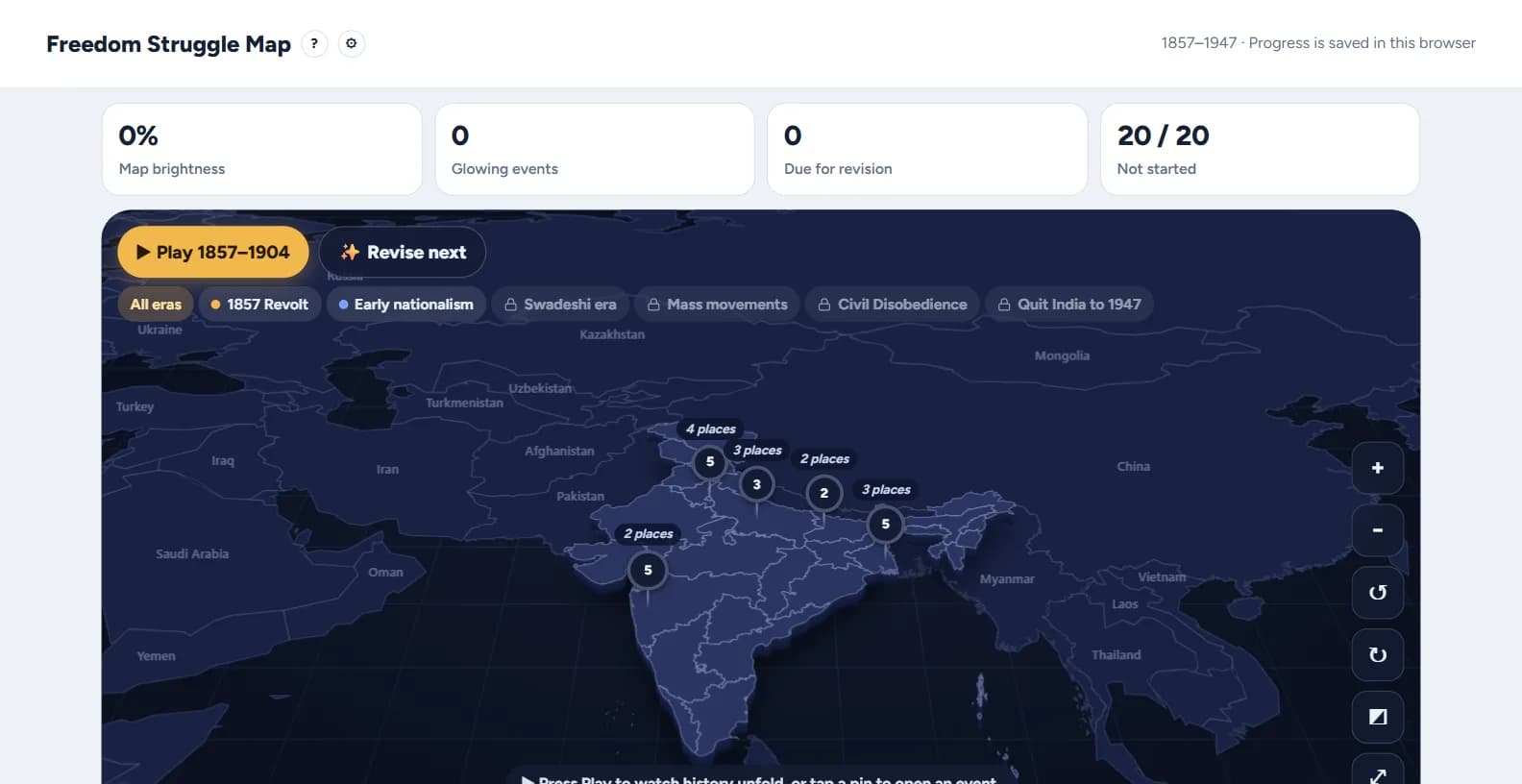
Why order and place matter in Modern History
Most Modern History questions are really about sequence or place. Was the Swadeshi movement before or after the partition of Bengal? Where was the Congress split? Which revolt came first? When you’ve seen events happen one after another on a map, the order stops being something you memorise and becomes something you remember seeing.
Six eras, one map
- Revolt of 1857 (1857–1859)Barrackpore and Meerut to Delhi, Kanpur, Awadh and Gwalior, place by place.
- Reform and early nationalism (1859–1904)The reform societies, the founding of the Congress and the first protests.
- Swadeshi to Home Rule (1905–1916)Partition of Bengal, the Surat split and the Home Rule Leagues.
- Gandhi's mass movements (1917–1929)Champaran, Non-Cooperation and the Lahore session.
- Civil Disobedience (1930–1938)The Dandi March, the Round Table Conferences and the Congress ministries of 1937.
- Quit India to Independence (1939–1947)Quit India, the INA trials, the Cabinet Mission and Partition.
Four tools for what UPSC asks most
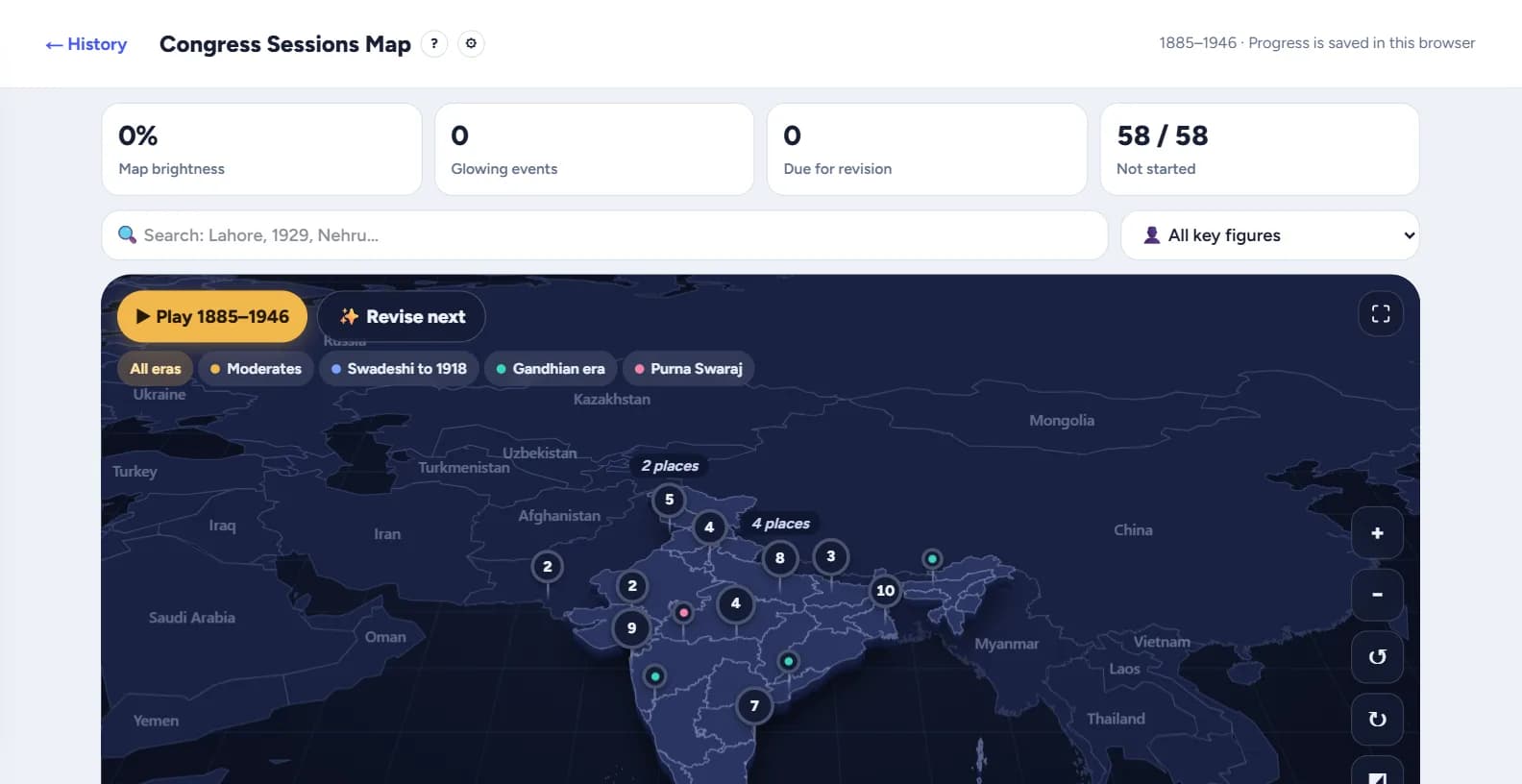
- Congress Sessions Ladder58 sessions from 1885 to 1947 on the map, each with its year, venue, president and main resolution.
- Constitutional Acts SliderSlide from the Regulating Act of 1773 to the Indian Independence Act of 1947 and see what each of 13 Acts changed.
- Revolts Map39 peasant, tribal and sepoy revolts by place, with a time filter, from the Sannyasi-Fakir rebellion onward.
- Leaders Network126 leaders, papers and organisations, linked to who founded or ran what, with 12 pairs students often mix up.
The pairs that cost marks
Leaders Network keeps a list of pairs that look alike. A few of them:
- Kesari and MarathaBoth Tilak's, both started in January 1881. Kesari was in Marathi, Maratha in English.
- Young India and NavajivanBoth Gandhi's weeklies of 1919. Young India in English, Navajivan in Gujarati.
- Mooknayak and Bahishkrit BharatBoth Ambedkar's Marathi papers. Mooknayak (1920) came first, Bahishkrit Bharat (1927) second.
Before 1857, and after 1947
- Rise of Company Rule Map1600 to 1856, from trading posts to an empire: Plassey, Buxar, the Mysore and Maratha wars, and the annexations.
- Post-Independence India Map1947 to 2023: the integration of the states, planning, wars, the Emergency, the regional accords and the coalition era.
- World History MapFrom the age of revolutions to the end of the Cold War in 1991, for World History in GS 1.
A week of Modern History
- Monday and Tuesday: one era a day on the Freedom Struggle Map. Press Play, then answer the questions.
- Wednesday: the Congress sessions of that period on the Ladder.
- Thursday: the Acts of that period on the Slider. Say what each one changed before you look.
- Friday: the revolts of that period on the Revolts Map.
- Saturday: Leaders Network, especially the mixed-up pairs.
- Sunday: write a one-page timeline of the period from memory, then check it.
Mistakes to avoid
Don'tRead the freedom struggle as a story once and hope the dates stay, or skip the "boring" Acts.
DoRevise one era at a time, in order, on the map, and answer the questions every time. The Acts and sessions are where the easy marks are.
Quick questions
- Is Modern History still worth the time for Prelims?
- Yes. History and Art & Culture make up a steady share of Prelims every year, and Modern History is the part most students can score in with revision alone.
- Does it help for Mains GS 1?
- Yes. Knowing the sequence and the place of an event gives a Mains answer its structure. Each event on the Freedom Struggle Map comes with key points you can use in an answer.
- What's free?
- The Freedom Struggle Map from 1857 to 1904 is free, with no account. Congress Sessions, Constitutional Acts, Revolts, Leaders Network and the other History maps are free with an account. The full Freedom Struggle Map to 1947 comes with Pro.