
Science and Tech in the News: Space Missions and New Tech, for UPSC
By IAS Labs by Aptness.ai · 4 min read ·
Prelims 2025 named three missions, Axiom-4, SpaDeX and Gaganyaan, and asked how many of them support microgravity research. Prelims 2026 asked about the National Quantum Mission. Science & Tech questions come straight from the news, but they test whether you understood the science, not whether you read the headline.
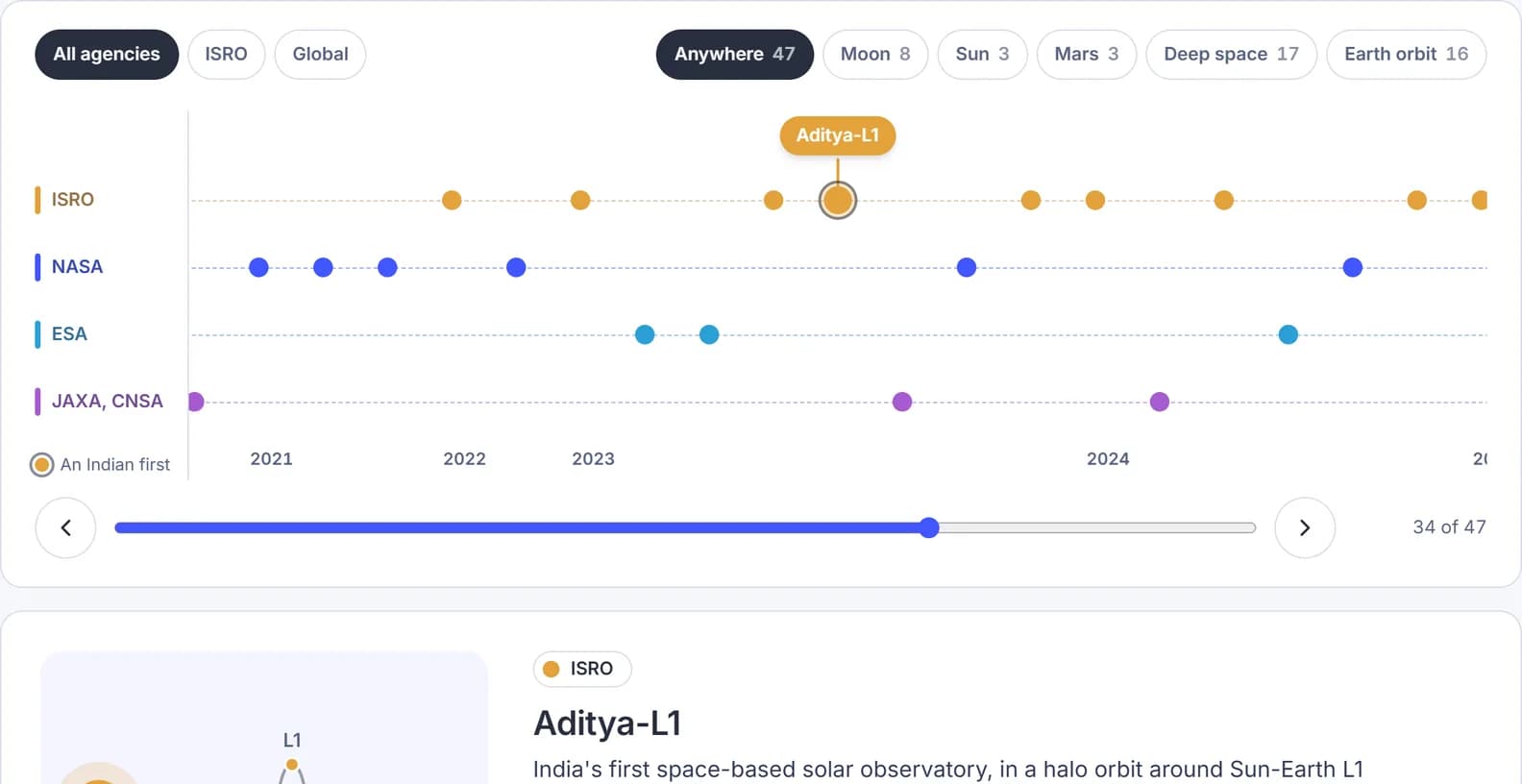
Space: the mission, the orbit, the first
For each mission, UPSC asks the same few things: who launched it, where it went, what kind of orbit, and what it did first. The timeline answers all four on one card. Aditya-L1, for example:
- Agency and rocketISRO, on PSLV-C57, launched 2 September 2023.
- Where it wentA halo orbit around the Sun-Earth L1 point.
- Why it mattersIndia's first space-based solar observatory, with an uninterrupted view of the Sun.
18 of the 47 missions are ISRO’s, from Aryabhata to Chandrayaan-3, Aditya-L1 and SpaDeX. The rest are the NASA, ESA, JAXA and Chinese missions that make the news, and the joint ones, such as NISAR and Axiom-4.
New tech, one step at a time
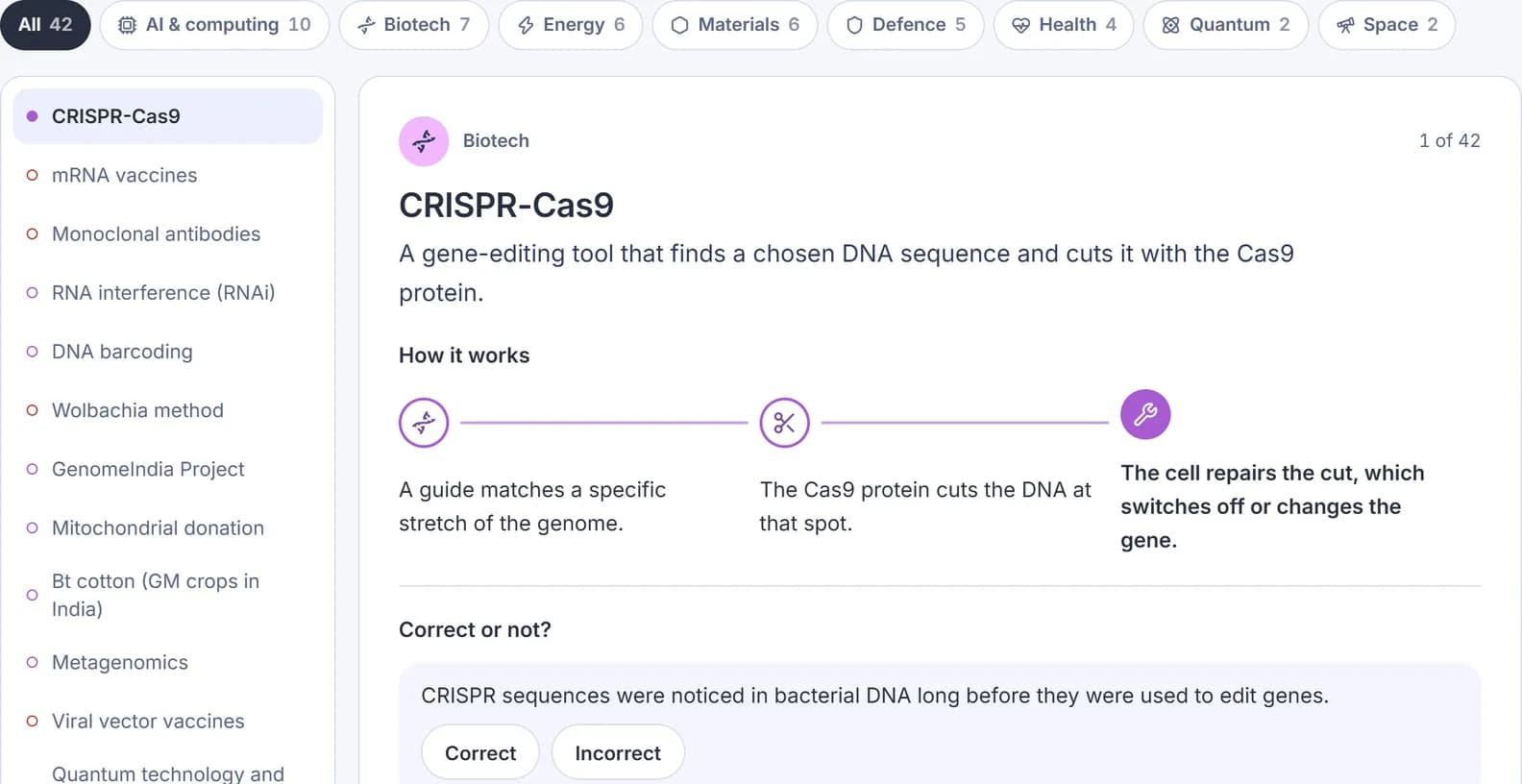
- Biotech and healthCRISPR-Cas9, mRNA and viral vector vaccines, monoclonal antibodies, the Wolbachia method, GenomeIndia.
- AI and computingLarge language models and the IndiaAI Mission, blockchain, 5G, IoT, digital signatures.
- Quantum and spaceThe National Quantum Mission, quantum key distribution, gravitational waves, exoplanet detection.
- Energy, materials and defenceGreen hydrogen, small modular reactors, graphene, rare earths, hypersonic missiles, drone swarms.
Each explainer has a one-line summary, the steps of how it works, and true-or-false traps. CRISPR in three steps: a guide matches a stretch of DNA; the Cas9 protein cuts it there; the cell repairs the cut, which switches the gene off or changes it.
News articles vs the tools
Studying from a PDF
Science tools
- A mission's orbit
- One line in a news story.The orbit drawn, with the agency and the first.
- How a technology works
- A long article, or none at all.A few plain steps.
- The traps
- You meet them in the exam.True-or-false traps on every topic.
- What UPSC asked
- Search old papers yourself.Real PYQs under "How UPSC asks this".
A 15-minute weekly habit
- When a launch or a new technology is in the news, open it in the timeline or the explainers the same day.
- Explain it out loud in three sentences: what it is, how it works, why India cares.
- Do its traps. Write the ones you got wrong in a "tricky facts" list.
- Once a month, scroll the whole timeline, lane by lane, and name each mission's first.
Mistakes to avoid
Quick questions
- I'm from an arts background. Is this too technical?
- No. Every explainer is written in plain steps, for a reader with no science background.
- Will it cover new missions?
- The timeline covers missions up to its last update. For anything newer, the daily current affairs quiz is where it shows up first.
- Do I need an account?
- Both tools are free with an account. Sign in with Google to open them.